
Showing posts with label foreclosures. Show all posts
Showing posts with label foreclosures. Show all posts
Wednesday, October 2, 2013
Vampires and Zombies - shades of foreclosures
Apparently, if you lose your home and then continue to live in it while paying rent to the bank that foreclosed on you, you may be harming the economy...part of a problem known as vampire foreclosures. But if you vacate your home, you may be hurting the economy by contributing to the number of zombie foreclosures. Cannot win for losing. LINK


Thursday, February 28, 2013
Why is "Domino" relevant?
I'm going to make this short...perhaps not sweet, but short.
In 2008, the United States led the world in entering the financial crisis, due to vastly over-valued real estate (read "homes, etc."), extremely risky financial dealings, and corruption. Thousands and thousands of people lost their homes, thousands and thousands of people lost their jobs.
In 2012, having only partly recovered from the economic crisis of 2008, the United States passed through two moments of brinkmanship when we were on the "fiscal cliff." Each time, at the last possible moment, Congress and the President managed to find a solution that avoided our falling over it.
As of this writing, the United States is less than 24 hours away from "sequestration," which is something that could well produce another and perhaps more serious financial crisis.
Is Domino: Caught in the Crisis relevant to the United States? You bet it is.
I could pepper this short article with photos of closed businesses and homes in foreclosure, but I've already posted those, you've seen those for yourselves, and I think it unnecessary to repeat them.
OUR NEXT BLOG POST will be about the CD release in the flamenco festival
Wednesday, October 5, 2011
Private greed and the economic crisis-part 2
As a specific example, I'll explain one specific loan package of which I am aware. This was a loan in which the borrower paid nothing but the interest for 10 years. Only after the 10 years were over would the borrower get to start paying down the principal...but shortly after starting to pay down the principal, there was a balloon payment.
In other words, for 10 years the bank gained everything and the borrower still owed exactly the same amount of principal. Then, when the borrower could start paying down the principal, after a very few months s/he had to pay it all--likely a financial impossibility.

"In the old days," such a loan would have been legally impermissible, on the theory that it was "unconscionable," meaning that it wasn't fair. But "banking reforms" made these loans legal, and thousands if not millions of people thoughtlessly signed on for them. A large proportion of these people now find themselves losing their homes after having paid many thousands of dollars to their bank or savings and loan without having touched the principal.
At first, the banks foreclosed in these cases. Now, because of the glut of foreclosed homes and the inability of people to pay back the loans, and with new federal incentives, the banks are putting more of these houses on the market as "short sales"--whereby the borrower loses his/her home, but the debt is wiped out once the house is sold.

Then, there was also the practice of writing loans without examining the borrowers assets...another way to ensure that people will sign up for more than they can afford. It also encourages speculation which encourages skyrocketing housing prices which encourages...until the bubble bursts.
And those institutions who thought they would simply take their money and run found themselves having taken a whole lot of money, but then being stuck with homes that, because of the burst bubble, were now worth much less than the principal (which hadn't been touched) and with borrowers who could no longer make their monthly payments.
I recently read that banks now own so much real estate through foreclosure that in some cases, they are finding it in their best interests to simply bulldoze the homes.

In many cases, they acquired these foreclosed homes by handing out loans almost impossible to pay, to people who couldn't afford to pay them. And these loans were made because of the greed of the lending institutions.
Bad stuff.
We'll talk about private greed in multinational corporations in later blogs.
THE NEXT BLOG WILL BE some THANKS to some of those that have helped us.
In other words, for 10 years the bank gained everything and the borrower still owed exactly the same amount of principal. Then, when the borrower could start paying down the principal, after a very few months s/he had to pay it all--likely a financial impossibility.

"In the old days," such a loan would have been legally impermissible, on the theory that it was "unconscionable," meaning that it wasn't fair. But "banking reforms" made these loans legal, and thousands if not millions of people thoughtlessly signed on for them. A large proportion of these people now find themselves losing their homes after having paid many thousands of dollars to their bank or savings and loan without having touched the principal.
At first, the banks foreclosed in these cases. Now, because of the glut of foreclosed homes and the inability of people to pay back the loans, and with new federal incentives, the banks are putting more of these houses on the market as "short sales"--whereby the borrower loses his/her home, but the debt is wiped out once the house is sold.

Then, there was also the practice of writing loans without examining the borrowers assets...another way to ensure that people will sign up for more than they can afford. It also encourages speculation which encourages skyrocketing housing prices which encourages...until the bubble bursts.
And those institutions who thought they would simply take their money and run found themselves having taken a whole lot of money, but then being stuck with homes that, because of the burst bubble, were now worth much less than the principal (which hadn't been touched) and with borrowers who could no longer make their monthly payments.
I recently read that banks now own so much real estate through foreclosure that in some cases, they are finding it in their best interests to simply bulldoze the homes.

In many cases, they acquired these foreclosed homes by handing out loans almost impossible to pay, to people who couldn't afford to pay them. And these loans were made because of the greed of the lending institutions.
Bad stuff.
We'll talk about private greed in multinational corporations in later blogs.
THE NEXT BLOG WILL BE some THANKS to some of those that have helped us.
Wednesday, September 28, 2011
Private greed and the economic crisis--part 1
Private greed has certainly played its part in the crisis. I know more about private greed in the United States than in Spain, so I'll turn to that country for my examples.
And for a start, I'll write about the private greed of mega corporations and the over-rich. Yes, in addition to private greed on the part of the big and powerful, there is private greed on the part of the little man. But in my opinion, private greed by the big and powerful has the capacity and the reality of doing much more harm. It's a question of scale.
I do not believe that all large private enterprises are bad. I do not believe all banks are bad. I do not believe all rich people are bad. But when one or all of these allows itself to be motivated by greed, then great harm comes to an awful lot of people.
Take the housing crisis. In addition to individuals who asked for an obtained loans which they were really not in a position to repay, there are the banks, savings and loans, home mortgage insurers, and all the rest that crafted the loans, that actively promoted the loans, that gave bonuses to employees who signed more loan contracts. And these loans were in large part the result of the deregulation of the Bush administration (although I understand that it started earlier, under Clinton).
But I digress.
THE NEXT BLOG WILL BE ABOUT private greed--specific examples of "unfair" loans
And for a start, I'll write about the private greed of mega corporations and the over-rich. Yes, in addition to private greed on the part of the big and powerful, there is private greed on the part of the little man. But in my opinion, private greed by the big and powerful has the capacity and the reality of doing much more harm. It's a question of scale.
 |
| An emblematic skyscraper of a multinational.. |
I do not believe that all large private enterprises are bad. I do not believe all banks are bad. I do not believe all rich people are bad. But when one or all of these allows itself to be motivated by greed, then great harm comes to an awful lot of people.
Take the housing crisis. In addition to individuals who asked for an obtained loans which they were really not in a position to repay, there are the banks, savings and loans, home mortgage insurers, and all the rest that crafted the loans, that actively promoted the loans, that gave bonuses to employees who signed more loan contracts. And these loans were in large part the result of the deregulation of the Bush administration (although I understand that it started earlier, under Clinton).
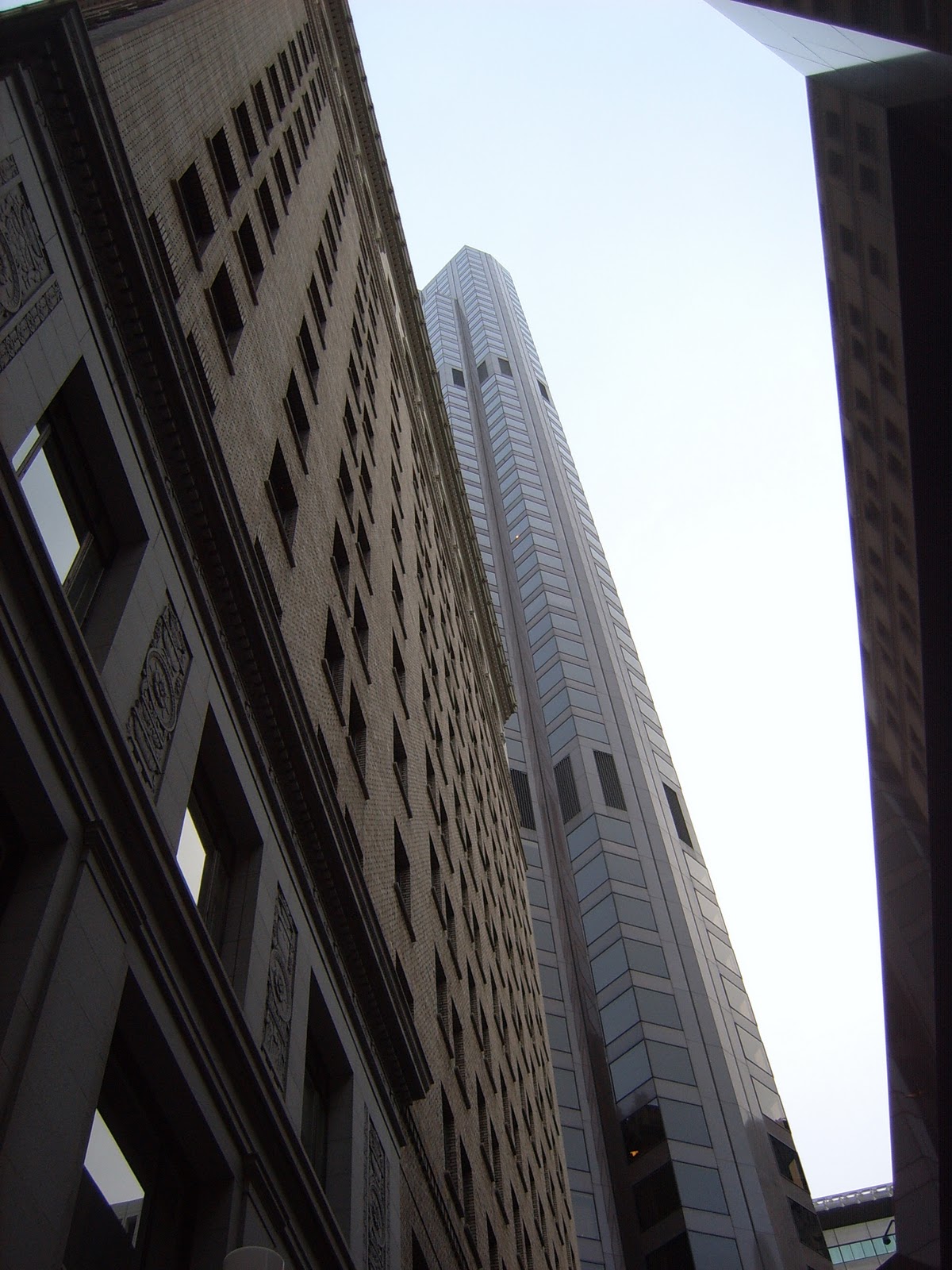 |
| These buildings project-intentionally, I believe-an image of power, might, and money. |
But I digress.
THE NEXT BLOG WILL BE ABOUT private greed--specific examples of "unfair" loans
Subscribe to:
Posts (Atom)