Showing posts with label greed. Show all posts

Monday, January 30, 2012

Private greed and the economic crisis, part 4-the little man (or woman)

We´ve said quite a bit over the past several months about the greed of banks, other large corporations, government, and the like.  But we have to admit that ordinary individuals have also contributed to the crisis by wanting more and more and more...by being greedy.

I´m referring here to people who took out huge loans backed by little or nothing in order to raise their lifestyle, when they already had plenty enough to eat, had a good roof over their heads, and had the possibility of taking an annual vacation.  I´m referring primarily to middle-class people who wanted three cars in the garage, or a nice boat, or a condo in some great vacation spot, or a major re-model of their house, etc., etc.--when in fact they didn´t have the income to afford it.


Instead of income, they relied on credit...LOTS and LOTS of credit.  Credit that they had expected to pay back when the housing market shot through the roof.  But...

Mostly unregulated credit, and unrealistic housing expectations, that helped drive up the price of houses to the point where very few people could any longer afford to buy.  Credit which was underwritten by, well, by...nothing, or close to it.

Credit which led to the bursting of the bubble.

I seriously do believe these people were a major cause in the bursting of the economic bubble.  I do NOT, however, think that they are the most responsible.  A too-optimistic individual almost never has as much control or responsibility as a corporation which makes it its business to be financially sophisticated and savvy, which is willing to cut corners and in some cases, engage in significant fraud, for reasons of personal or corporate benefit.

NOTE:  As a further illustration, I meant to shoot a photo of a home with a garage fitted out for 3 cars, but left California before doing so! Uh oh.

But it remains true that if the private, middle-class individual had not been willing to contract for so much debt, if the "me" factor hadn´t been so important, if people were more willing to be content with what they had or what they could in fact pay for out of their own pockets, then they wouldn´t have been such easy prey for the blandishments of those financial institutions and others who were not operating in a manner so as to benefit the public good.

Which makes it clear that I believe in the public good more than private acquisition, and in savings more than loans.  We all have our preferences.

OUR NEXT POST will be about our screening on Jan. 26 in California.

Wednesday, January 11, 2012

Private greed and the economic crisis, part 3-big corporations, big money

This will be the last post about the greed of the high and mighty.  I'll then finish off the topic with a blog about the greed of the little man (and woman) and that should be the end of my rantings about greed.

Multinationals and huge businesses--nothing by definition wrong with either of these, although I personally prefer small businesses where the owner is there running the shop, with maybe a couple of employees.  More friendly, more personal, more we're-neighbors-and-we're-in-this-together.


But ok.  We have a big world, with lots of international communications;  and multinationals plus very big businesses are going to be a part of it.

What I do NOT like, however, is businesses whose chief focus is on raising the level of their profits, or cornering the market, or driving the small shops out of business.  And I also really dislike businesses--and here, it's pretty much exclusively very big businesses that do this--who in the name of efficiency and productivity replace workers in positions that are not arduous with machines.

I'm not talking about assembly lines, or tractors, or that kind of thing.  I'm talking about all those machines that answer the phones.  And all those other machines which, once the basics of letting machines do the back-breaking work, go on to do work which human beings can easily handle and traditionally have, machines that are purchased do so as to let the company fire their workers and not have to worry about paying higher wages or awarding better benefits packages.

So sure, you probably want your automobile assembly line mechanized, but when you mechanize beyond a certain extent, you create unemployment.  There needs to be a balance.

[NOTE:  I´d planned a photo of a homeless shelter or other relevant image but on contacting one, find that it needs to be arranged "through channels," so if they decide to give me information, I´ll do a separate blog specifically on that center.]

Surely this is something government can do--reward job creation instead of wealth creation.  Figure out about how many working adults you'll have in the country, and encourage big businesses to have that many positions available.

And big businesses, instead of having the steadily rising profits that they have now, even as unemployment is way too high, could determine that they would raise wages and/or create new jobs instead of allowing profits to continue rising when the gap between rich and poor is growing, and there are 14 million people looking for work.

THE NEXT BLOG will be about our screening on Jan. 26..

Wednesday, October 5, 2011

Private greed and the economic crisis-part 2

As a specific example, I'll explain one specific loan package of which I am aware.  This was a loan in which the borrower paid nothing but the interest for 10 years.  Only after the 10 years were over would the borrower get to start paying down the principal...but shortly after starting to pay down the principal, there was a balloon payment.

In other words, for 10 years the bank gained everything and the borrower still owed exactly the same amount of principal.  Then, when the borrower could start paying down the principal, after a very few months s/he had to pay it all--likely a financial impossibility.


"In the old days," such a loan would have been legally impermissible, on the theory that it was "unconscionable," meaning that it wasn't fair.  But "banking reforms" made these loans legal, and thousands if not millions of people thoughtlessly signed on for them.  A large proportion of these people now find themselves losing their homes after having paid many thousands of dollars to their bank or savings and loan without having touched the principal.

At first, the banks foreclosed in these cases.  Now, because of the glut of foreclosed homes and the inability of people to pay back the loans, and with new federal incentives, the banks are putting more of these houses on the market as "short sales"--whereby the borrower loses his/her home, but the debt is wiped out once the house is sold. 


Then, there was also the practice of writing loans without examining the borrowers assets...another way to ensure that people will sign up for more than they can afford.  It also encourages speculation which encourages skyrocketing housing prices which encourages...until the bubble bursts.

And those institutions who thought they would simply take their money and run found themselves having taken a whole lot of money, but then being stuck with homes that, because of the burst bubble, were now worth much less than the principal (which hadn't been touched) and with borrowers who could no longer make their monthly payments.

I recently read that banks now own so much real estate through foreclosure that in some cases, they are finding it in their best interests to simply bulldoze the homes.


In many cases, they acquired these foreclosed homes by handing out loans almost impossible to pay, to people who couldn't afford to pay them.  And these loans were made because of the greed of the lending institutions.

Bad stuff.

We'll talk about private greed in multinational corporations in later blogs.

THE NEXT BLOG WILL BE some THANKS to some of those that have helped us.

Wednesday, September 28, 2011

Private greed and the economic crisis--part 1

Private greed has certainly played its part in the crisis.  I know more about private greed in the United States than in Spain, so I'll turn to that country for my examples.

And for a start, I'll write about the private greed of mega corporations and the over-rich.  Yes, in addition to private greed on the part of the big and powerful, there is private greed on the part of the little man.  But in my opinion, private greed by the big and powerful has the capacity and the reality of doing much more harm.  It's a question of scale.

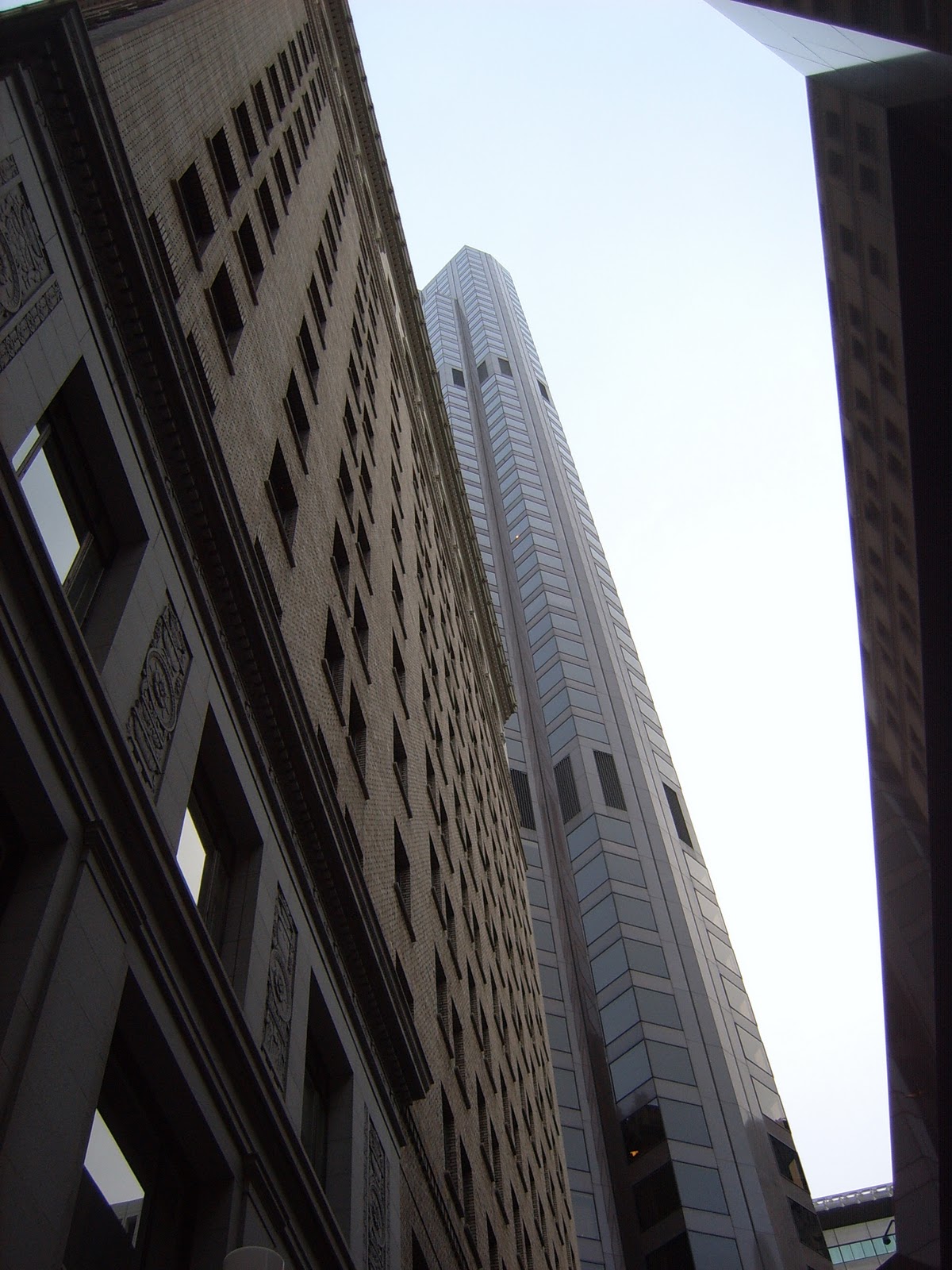
An emblematic skyscraper of a multinational..

I do not believe that all large private enterprises are bad.  I do not believe all banks are bad.  I do not believe all rich people are bad.  But when one or all of these allows itself to be motivated by greed, then great harm comes to an awful lot of people.

Take the housing crisis.  In addition to individuals who asked for an obtained loans which they were really not in a position to repay, there are the banks, savings and loans, home mortgage insurers, and all the rest that crafted the loans, that actively promoted the loans, that gave bonuses to employees who signed more loan contracts.  And these loans were in large part the result of the deregulation of the Bush administration (although I understand that it started earlier, under Clinton).

These buildings project-intentionally, I believe-an image of power, might, and money.

But I digress.

THE NEXT BLOG WILL BE ABOUT private greed--specific examples of "unfair" loans

Tuesday, July 26, 2011

Public greed, public corruption and the crisis--part 2

[This is the second in a two part series.]

So what is the connection between public greed, public corruption and "Domino?"  And what is their connection with the crisis?

To begin with without public greed, public corruption and the misappropriation of funds, we'd have much less of a crisis, and "Domino's" hero would surely have a job.

Why do I say that?  To start off with, back in the "real" world, imagine that all those millions that have disappeared--and here, I'm referring not only to the millions that vanished from the Ciudad de Flamenco project, but the other millions that we can guess have disappeared from other large projects--imagine that they did not vanish, but instead were used for their intended purpose.

Next, imagine that those bloated salaries were brought down to a more reasonable level.  Imagine that public functionaries knew how to do their jobs.

Let's even imagine that political leaders decided not to engage in nepotism and that only those people were hired who were actually needed to run the city (or the region, or the country, or whatever).

Nepotism?  A former mayor had a brother-in-law who raised palm trees.

Well, I think we'd see a huge savings.  I think we'd see much less public debt.  (Public debt for the city of Jerez de la Frontera is now running at more than 6 million Euros, according to the newspapers--and that is a substantial chunk of cash.)

And with those savings, just imagine where we'd be.   Not only would the city not be in debt but...

A news article recently reported that 790 FAMILIES would no longer be getting public assistance.  These are families where no one is able to get a job.  They're victims of the high unemployment level (which runs between 22% and 50%, depending on the source you use).

That number of FAMILIES, here in a country in which divorce is very uncommon and the typical family has between 2 and 6 kids, means around 4,000 and 6,000 PEOPLE. With the savings realized by magically eliminating public greed, surely those people would get their public assistance.  The family head(s) might even be able to get a job and move OFF of public assistance.

The unfortunate Ciudad de Flamenco would probably still be under construction.

The Teatro Villamarta--the main theater of Jerez de la Frontera

The city would be paying its bills.  Right now, the city is in arrears on paying for garbage collection, paying for the electricity for street lights, and paying the artists who put on productions in the city's main theater.  That theater hosts the opera and other major public performances.  It also hosts the annual, world-famous  International Flamenco Festival which brings the city many, many millions of Euros from tourists.

In a word, if we used our magic wand and eliminated public greed, we'd be awfully near utopia.

NEXT POST:  Why Jerez de la Frontera?

Saturday, July 23, 2011

Public greed, public corruption and the crisis--part 1

This will be a blog post about the public kind of greed, which leads to public corruption and is one of the major elements that led to the current economic crisis and helped inspire me to make "Domino:  caught in the economic crisis."  Other than providing some of the inspiration,  what, you may ask, does public greed have to do with "Domino?"  I´ll answer THAT question in the NEXT blog.

Since I´m in Jerez de la Frontera, I´ll focus on public greed right here at my doorstep, but in the back of my mind is the public greed I saw growing up in New Orleans;  the public greed in places like Chicago, New York, Detroit, and Washington, D.C. that used to make national headlines;  and in India, Mexico, Egypt, Japan....

In Jerez, I can see something out of my front window that is called the "Ciudad de Flamenco," or "City of Flamenco."  It is a construction project which is supposed to result in a major facility including theater, space for classes, etc.--a BIG theater, etc.  It has been in the works for years.

The Ciudad de Flamenco--the contractors recently left the site.

The city, the Spanish national government, and I believe even the European Union have contributed funds.  But a recent newspaper article revealed that of the 3 million Euros the city had for the project, 2.7 million Euros had disappeared before construction began.  Now, it didn't simply walk away.  It has to be in someone's pocket.

In the meantime, after four years of "being under construction,"  what we have is a massive concrete base covered by a fair amount of dirt.  And that's it.  So far.  (Since the building design is one I find to be extremely ugly and I think the entire project is ill-conceived, this may not be a totally bad thing, but WHERE are those millions?)

Local newspapers also reported, last year, that the salary for the mayor here (at least up until the last election) as well as for a large number of city department heads is greater than the salary for the director of the entire geographic region (Andalucia).  The region consists of many, many cities plus agricultural regions in between--surely more work.

Jerez' city hall

And many city departments are headed by people who have no background--and often no interest--in the work of the department they direct.  Excuse me, but this is also a form of greed...to be willing to be paid large sums of money to do something for which you are not qualified and in which you may also have absolutely no interest.

NEXT POST:  Public greed and...the Teatro Villamarta, the city's bills, even palm trees.  (Palm trees?  Sure.  Palm trees.)

P.S.  Check out the photos at the bottom of this post!